An Academy Of Spatial Agents Generating Spatial Configurations With Deep Reinforcement Learning
Publication Conference Paper2020

An Academy of Spatial Agents - Generating spatial configurations with deep reinforcement learning

Abstract

Agent-based models rely on decentralized decision making instantiated in the interactions between agents and the environment. In the context of generative design, agent-based models can enable decentralized geometric modelling, provide partial information about the generative process, and enable fine-grained interaction. However, the existing agent-based models originate from non-architectural problems and it is not straight-forward to adapt them for spatial design. To address this, we introduce a method to create custom spatial agents that can satisfy architectural requirements and support fine-grained interaction using multi-agent deep reinforcement learning (MADRL). We focus on a proof of concept where agents control spatial partitions and interact in an environment (represented as a grid) to satisfy custom goals (shape, area, adjacency, etc.). This approach uses double deep Q-network (DDQN) combined with a dynamic convolutional neural-network (DCNN). We report an experiment where trained agents generalize their knowledge to different settings, consistently explore good spatial configurations, and quickly recover from perturbations in the action selection.

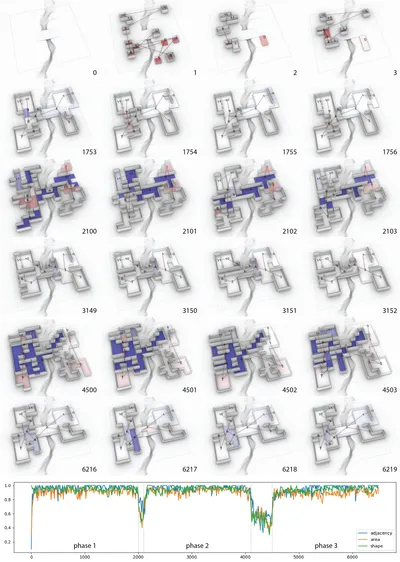
Rows1-6: simulation of 12 agents in a terrain with a bridge over a stream. Every pair of rows contain the first 4 steps in a
stage of the simulation and 4 steps selected visually. Row 7: graph with the
average performance of the agents (y axis) over the episode (x axis).
The areas between dotted lines indicate the periods where action was selected randomly (perturbation).
Rows1-6: simulation of 12 agents in a terrain with a bridge over a stream. Every pair of rows contain the first 4 steps in a stage of the simulation and 4 steps selected visually. Row 7: graph with the average performance of the agents (y axis) over the episode (x axis). The areas between dotted lines indicate the periods where action was selected randomly (perturbation).
How This Connects
Pedro VelosoPedro VelosoRamesh KrishnamurtiRamesh Krishnam…Integrating building footprint prediction and building massing - an experiment in PittsburghIntegrating bui…Robotic free-oriented additive manufacturing technique for thermoplastic lattice and cellular structuresRobotic free-or…Multimodal Word Sense Disambiguation in Creative PracticeMultimodal Word…Multimodal Word Sense Disambiguation in Creative PracticeMultimodal Word…Multi-resolution in architecture as a design driver for additive manufacturing applicationsMulti-resolutio…Context-rich Urban Analysis Using Machine LearningContext-rich Ur…
An Academy of Spatial Agents - Generating spatial configurations with deep reinforcement learning
Open in Constellation View