SENTIENT CONCRETE
Dana Cupkova, Daragh Byrne, DAN CASCAVAL
Abstract
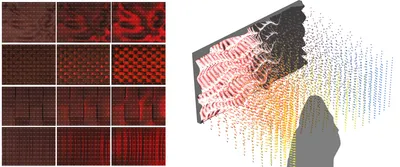
Historically, architectural design focused on adaptation of built environment to serve human needs. Recently embedded computation and digital fabrication have advanced means to actuate physical infrastructure in real-time. These ‘reactive spaces’ have typically explored movement and media as a means to achieve reactivity and physical deformation (Chatting et al. 2017). However, here we recontextualize ‘reactive’ as finding new mechanisms for permanent and non-deformable everyday materials and environments. In this paper, we describe our ongoing work to create a series of complex forms modular concrete panels- using thermal, tactile and thermochromic responses controlled by embedded networked system. We create individualized pathways to thermally actuate these surfaces and xplore expressive methods to respond to the conditions around these forms the environment, the systems that support them, their interaction and relationships to human occupants. We outline the design processes to achieve thermally adaptive concrete panels, illustrate interactive scenarios that our system enables, and discuss opportunities for new forms of interactivity within the built environment.
More by these authors