Breathing Intelligence: Morphological Computation in Inflatable Swarm Systems
MSCD
AdvisorsDaragh Byrne, Paul Pangaro
Abstract
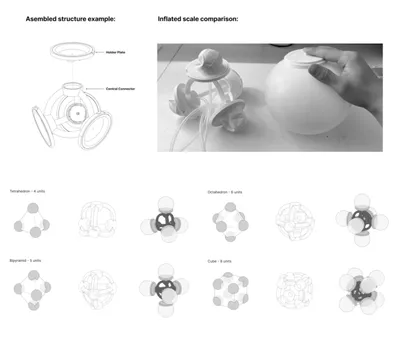
Soft robots gain their abilities as much from their shape as from their control, yet the choice of shape is rarely systematic. Modular robots, by contrast, offer design spaces that can be compared and studied — but most modular robots today are rigid, leaving the combination of modularity and soft inflation largely unexplored. This thesis works in that gap. It asks how the arrangement of modules in an inflatable robot shapes its ability to move, and how few modules are enough to support controllable motion under a cost–mobility trade-off. This question comes from a common trade-off in soft robot design: adding more modules increases what a robot can do but also raises its cost and control complexity, while simpler setups may lose the ability to move at all. To study this trade-off, I propose a family of robots built from identical spherical inflatable modules placed on the vertices of cospherical polyhedra — tetrahedron, bipyramid, octahedron, and cube — so that different configurations share one geometric language and can be compared on equal terms. The thesis argues that, in soft modular systems, configuration is not just a container for control but part of it.