Designing For Accessible Sidewalk Robots – Insights From People With Motor Disabilities
MSCD
AdvisorsDaragh Byrne, Sarah Fox, Nikolas Martelaro
Abstract
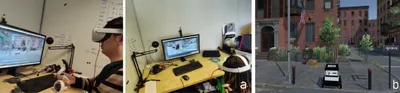
Sidewalk robots, such as delivery robots, are becoming increasingly common worldwide, as they offer companies a more sustainable and affordable last-mile delivery service. Despite their advantages, the use of sidewalks by these robots for their operations presents challenges for other co-present sidewalk users of the shared space, especially vulnerable road users like people with motor disabilities (PWMD). These individuals have already proven to encounter more obstacles while navigating sidewalks, and the presence of sidewalk robots may exacerbate these difficulties. Therefore, there is a pressing need to investigate how the various design factors related to sidewalk robots might impact the daily navigation of people with motor disabilities. Also, as a new form of Human-robot interaction(HRI) is happening in public spaces, there is also a lack of evaluation tools to replicate the behavior of the robots and test how they alter the navigation experience of PWMD. I approached this problem through two distinct but interrelated inquiries. Firstly, a Wizard-of-Oz (WoZ) virtual simulation tool was developed to emulate and examine HRI between sidewalk users and delivery robots in street environments. Preliminary studies using this tool, both through video interviews and immersive virtual reality experiences, demonstrated its potential to foster meaningful design conversations. Subsequently, I conducted semi-structured interviews with ten PWMD to gain insights into their perceptions, interaction preferences, and attitudes towards the emerging presence of sidewalk robots. The qualitative analysis of these interviews led to the identification of 23 themes, clustered into three categories. These encompassed potential influences of sidewalk robots on PWMD, scenarios of interaction between PWMD and these robots, and emerging opportunities for design enhancement. As public spaces become increasingly populated with robots, my findings argue for the necessity of more robust evaluation tools to facilitate the design of accessible sidewalk robots that align with established social norms. Virtual simulation tools can play a pivotal role in this process, complementing real-world tests and providing crucial data to inform design decisions. The insights gleaned from my research can contribute to the development of equitable deployment guidelines for sidewalk robots and inspire further investigation into the impact of emerging public robots on vulnerable populations.