Playful computation: Encounters with ephemeral surfaces.
MSCD
Carla Flores Trávez, Carla Flores-Travez
AdvisorsJoshua Bard, Daragh Byrne, Golan Levin, Vina Wei
Abstract
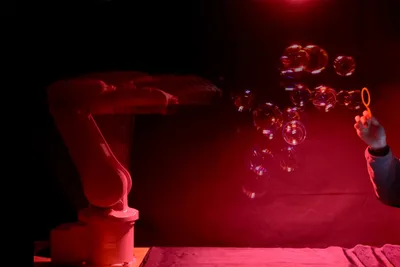
This thesis explores robotics as a medium for play, curiosity, and material exploration through a series of experiments involving a robotic arm and soap bubbles. The project investigates how robotic systems can engage with ephemeral materials in ways that foreground perception, interaction, and embodied experience rather than optimization alone. Across iterative prototypes, two primary interaction modes were developed: path-planned scenarios based on scripted motion, and sensing-driven scenarios using computer vision and externally guided motion. These approaches were used to compare how robotic behavior changes when interaction depends on timing and coincidence versus real-time feedback and tracking. Soap bubbles, as fragile and ephemeral materials, introduce constraints of lifespan, drift, and unpredictability that challenge conventional robotic precision. Findings suggest that successful interaction emerges through alignment between robot motion, material behavior, and human participation. Depending on these conditions, the robot may be perceived as an instrument, collaborator, or participant. Moments of failure, delay, and surprise become central to the inquiry, revealing how uncertainty can generate engagement and disrupt a traditional deterministic system. The thesis contributes to computational design and human–robot interaction by proposing a playful and material-centered approach to robotics, where interaction is understood as relational, time-based, and continuously negotiated.