Semantic Compilation for Iterative Design : Bridging Natural Language design explorations and Construction-Aware Modeling
MSCD
AdvisorsJoshua Bard, Jimmy Cheng
Abstract
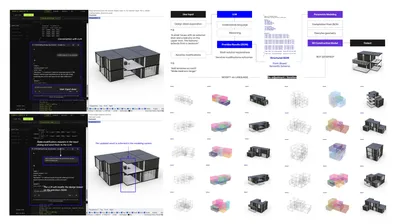
This research proposes a structured methodology for bridging open-ended natural language design intent and construction-aware geometric modeling, supporting designers in early-stage idea exploration and iterative modification while generating construction-aware models for further development. Current approaches lack a clear mechanism to translate between these two fundamentally different representations, requiring designers to manually convert between them, resulting in inefficiency and redundant effort. Instead of relying on direct text-to-geometry generation, the approach introduces a point-defined intermediate representation with semantic encoding, enabling language models to operate at the level of spatial reasoning while delegating detailed assembly logic to a parametric modeling system. The framework establishes a coordinated workflow that supports natural language–based exploration and iterative modification, while ensuring deterministic and construction-aware geometric execution. Experimental results show that the proposed representation significantly improves the stability, interpretability, and constructability of generated designs. The findings suggest that the effectiveness of language-based design systems depends not on end-to-end generation, but on structured representation and system-level coordination. This work contributes a methodological framework for integrating language-based reasoning into architectural design workflows, supporting both exploratory design processes and construction-aware modeling.