Bridging the Explainability Gap in Vibe Coding:From Black-Box Generation to Cognitive Support for Design Iteration
MSCD
AdvisorsDaniel Cardoso Llach, Nik Martelaro
Abstract
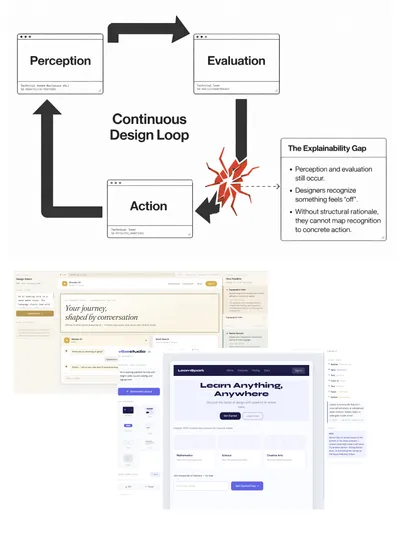
Generative AI is reshaping design workflows by enabling designers to produce complete interfaces from high-level intent. While these systems accelerate prototyping, they also reconfigure how designers interact with their work, often shifting design from an iterative process into a sequence of discrete stages such as generation and editing . As a result, the continuity of design reasoning—how designers perceive, evaluate, and act during iteration—becomes increasingly difficult to sustain. This work reexamines AI-assisted design from a process-oriented perspective. We conceptualize design as a continuous loop of perception, evaluation, and action, in which understanding emerges through ongoing interaction rather than fully specified decisions. Building on this framing, we argue that current AI-assisted workflows disrupt this loop, particularly by weakening the transition from evaluation to action. To investigate this issue, we design a prototype system that integrates AI support within the design loop, rather than treating AI as an external generator of outputs. The system focuses on supporting designers at the moment where partial judgments are formed and translated into action. We then conduct a task-based user study to examine how different forms of interaction support influence designers’ iteration strategies and decision-making. Our findings show that when the continuity between evaluation and action is supported, designers are more likely to engage in incremental refinement rather than repeated regeneration, and demonstrate clearer reasoning about their design decisions. These results suggest that the value of AI in design lies not only in generating outcomes, but in sustaining the processes through which design thinking unfolds.