Towards a Machine Learning Framework in Space Syntax
MSCD
Cecilia Ferrando, C
AdvisorsDaniel Cardoso Llach, Peter Scupelli
Abstract
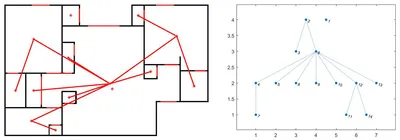
Space Syntax is a set of theories and methods for the computational analysis of spatial configurations. Looking at Space Syntax methods and its ambition to study the qualitative aspects of space, this thesis addresses the following novel research questions: how can we build a Machine Learning modelof learnable Space Syntax rules? How would a Machine Learning framework prove a useful tool inthe analysis of architectural qualities? Two commonly adopted techniques used in spatial analysis are isovists, introduced by MichaelBenedikt (1979), and graph theory, explored in architecture by Christopher Alexander, but dating back to XVIIIth century France. Such techniques have the potential to convey different types of information on architectural space - visual connectivity on one side, hierarchies and accessibility onthe other. The quality of architectural privacy in houses is chosen as object of further analysis.The potential relationships between a vector of spatial features and the variable of privacy arevalidated in experimental settings; in order to prove the feasibility of building a large dataset of floorplans labeled according to these spatial features, a software extracting spatial features out of image data is outlined in its structure. Finally, a newly proposed Machine Learning framework for Space Syntax analysis is presented anddiscussed. To provide a proof-of-concepts for the usefulness of Neural Networks in Space Syntax,statistical analysis on a relatively small dataset of spaces in house floor plans is run, proving that it ispossible to find patterns relating Space Syntax features and the level of intimacy of different rooms in a house floor plan, and puts in evidence the fact the need for a more complex function approximator to define those patterns. These results reinforce the usefulness of a Machine Learning framework in Space Syntax, and of its analytic - and in perspective generative - potential applications.