What Drawings Say That Drawers Don’t: Surfacing Implicit Visual Patterns from Personal Drawing Archives Through Vision-Language Models
MSCD
Abstract
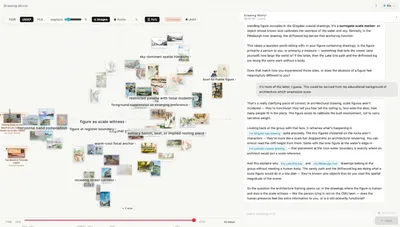
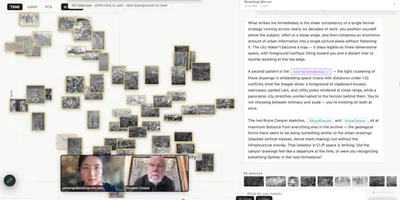
Artists and hobbyists who draw regularly accumulate archives that encode, over years, the patterns of their visual attention, including what they consistently notice, frame, and return to, in ways that neither they nor their audiences can easily articulate. Drawing Mirror is a reflective tool that makes these implicit patterns legible. The system maps a personal drawing archive into a shared semantic space using CLIP embeddings, then supports a dialogue between the drawer and a vision-language model to identify, name, and spatially anchor recurring visual themes. The central artifact is the theme phrase — a label co-produced by AI and drawer that simultaneously occupies language space and image space, and accumulates meaning as the archive grows. This structure supports three activities: surfacing patterns the drawer was not explicitly aware of; situating those patterns within art-historical precedent by retrieving comparable works from a large external collection; and detecting temporal evolution to anticipate where the practice may be heading. The prototype was developed through five design iterations and evaluated across two case studies using a prototype-to-ask-questions methodology: the author's decade-long watercolor archive and a drawing instructor's multi-decade archive. The thesis contributes a working system, a framework for treating personal drawing archives as implicit self-data, and design principles for AI tools that support reflection on creative practice rather than generation of new work.