A Computational Framework For Robotic Quality Assessment And Management In Construction
Publication Conference Paper2022

A Computational Framework For Robotic Quality Assessment and Management In Construction

Abstract

As an integrated process in construction projects,quality assessment and management (QA&M) can be importantto prevent failures during construction. The existing QA&Mpractice such as the evaluation of the geometric tolerance andsurface qualities is mostly performed manually which can belabor-intensive and tedious. This study proposes a computationalframework for a robot to perform automatic QA&M in unknownenvironments. The framework is composed of three parts: (1)motion planning; (2) defect detection; and (3) defect registration.The motion planning component generates efficient robotic pathfor autonomous exploration and surface inspection. The defectdetection component quantifies surface anomalies within a userdefinedarea of interests through multiple sensor measurements.The defect registration component localizes the detected defectsand registers the defects to a site model. To demonstrate thefeasibility of the proposed framework, we present a user case forassessing geometric tolerance and surface quality of a 1500 mm(L) x 745 mm (W) x 1980 mm interior wall mockup. The resultof the case study shows that the proposed framework has thepotential to provide reliable geometric measurement and defectdetection for gypsum wall panels in a lab environment.

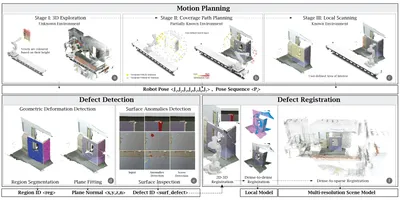
Fig. 1. The computational framework of the robotic QA&M system: (a) Frontier-based autonomous exploration in an unknown environment (b) Viewpoint generation and path planning based on information gain for covering a user-defined search space in a partially known environment (c) Local scanning path planning for covering a user-defined surface in a known environment (d) Geometric deformation detection (e) Surface anomalies detection (f) Defect registration — 2D images are registered to the target 3D surface based on known extrinsic and intrinsic parameters. local dense point clouds obtained from the same
source are registered through ICP [1]. Local dense point clouds are registered to a sparse scene model through the cluster ICP framework [2].
Fig. 1. The computational framework of the robotic QA&M system: (a) Frontier-based autonomous exploration in an unknown environment (b) Viewpoint generation and path planning based on information gain for covering a user-defined search space in a partially known environment (c) Local scanning path planning for covering a user-defined surface in a known environment (d) Geometric deformation detection (e) Surface anomalies detection (f) Defect registration — 2D images are registered to the target 3D surface based on known extrinsic and intrinsic parameters. local dense point clouds obtained from the same source are registered through ICP [1]. Local dense point clouds are registered to a sparse scene model through the cluster ICP framework [2].
How This Connects
Jingyang LiuJingyang LiuYumeng ZhuangYumeng ZhuangJoshua BardJoshua BardTowards Adaptive Additive Manufacturing Image-based Monitoring for Binder Jet 3D Printing of Coarse Composite Concrete PowdersTowards Adaptiv…Robust Visual SLAM with Integrated UWB Positioning for Construction RoboticsRobust Visual S…Proxemic-aware Augmented Reality For Human-Robot InteractionProxemic-aware …Towards Adaptive Additive Manufacturing with Semi-autonomous Robotic Binder Jet 3D Printing of ConcreteTowards Adaptiv…Computational design and fabrication of highly customizable architectural space frames: Making a flat-cut Weaire-Phelan structureComputational d…
A Computational Framework For Robotic Quality Assessment and Management In Construction
Open in Constellation View