Form data as a resource in architectural analysis: an architectural distant reading of wooden churches from the Carpathian Mountain regions of Eastern Europe
Abstract
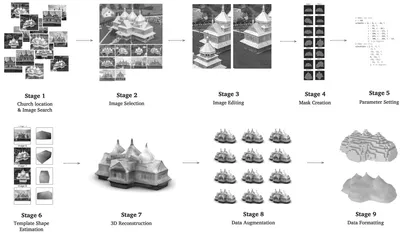
Recent research into architectural form analysis using deep learning (DL) methods has shown potential to identify features from large collections of building data, shedding new light into formal aspects of our built environment. As these methods begin to enter architectural, urban, and policy design contexts, it becomes important to develop critical approaches to employing them. In this paper, we document and reflect upon our efforts to create a custom dataset of 3-D models of 331 wooden churches located within the Carpathian Mountains of Eastern Europe, and to use DL methods to explore this dataset with the goal of revealing unexpected formal traits and advancing architectural scholarship on this subject. While existing scholarship groups them into four distinct stylistic categories, our analysis reveals stylistic overlaps, previously undetected micro styles, and shared architectural features. We posit the resulting analyses as an example of an ‘architectural distant reading’ that enriches our understanding of this architectural typology through an unprecedentedly detailed portrait of its formal characteristics based on a large architectural dataset. Crucially, drawing on recent developments in critical data and algorithm studies, we show how the dataset construction and subsequent analyses, and their results, were shaped by slow, manual data curation processes, methodological constraints, subjective decisions, and engagements with archives, domain experts. We thus illustrate how DL techniques might be contextualized for architectural studies in relation to other modes of knowledge and labour, and offer a detailed case study of state-of-the-art computational methods enriching established approaches to architectural form and historical analysis.
More by these authors