Responsive Robotic Assembly with Heterogeneous Materials: A Case Study with Unprocessed Wood
Abstract
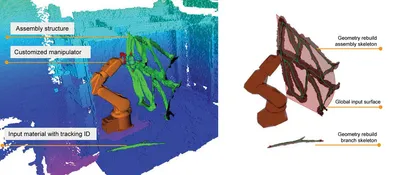
This paper explores how robotic automated assembly can be adapted towards architectural materials, and develops a dual planning and design framework between ROS (Robot Operating System) and Grasshopper for responsive assembly with non-standardized tree branches. The framework synthesizes features of adaptive path planning, material analysis, and parametric design as an efficient and dynamic feedback system to adjust robot trajectory planning and design decision-making. It creates the potential for adaptive mass-customized fabrication with heterogeneous natural materials. The paper documents iterate research and testing leading to a series of prototypes using wood branches collected in local parks and forests as test materials. Approaching these through a bi-directional, real-time system, we bypass industrial standardization; confront geometric and tectonic challenges unique to irregular, biological forms; and evaluate the system's performance. The framework embodies techniques in 3D map generation and calibration through sensors, empirical design solver, and data efficiency organization. This distributed, resourceful approach to fabrication challenges the historical tendency of automation technologies towards increased mass standardization and capital concentra tion. The attention to direct employment of non-standardized raw wood not only supports biologically inspired computational designs, but also ecologically friendly fabrication practices that scavenge waste materials and save costs from material-standardization treatment. Responding to the global concerns of waste management and resource repur posing, the research seeks to contribute towards an equitable, ecological, architectural design practice with computation and semi-autonomous robots.
More by these authors