Space as Interface: A Computational Framework for Spatial Computing in Robotically-Assisted Construction
PhD-CD
AdvisorsDaniel Cardoso Llach, Joshua Bard, Mayank Goel
Abstract
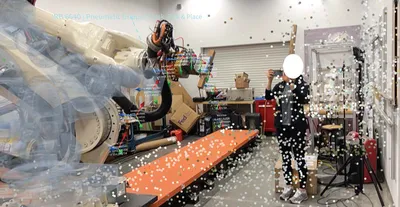
Since the early 1970s, many studies have explored integrating robotic systems into architecture, engineering, and construction (AEC) to address challenges like low productivity, worker shortages, and safety concerns. Efforts have aimed to automate construction. However, complexities such as job site environments, worker safety, and economic factors limit fully unmanned systems in AEC. The increasing trend of robotically-assisted practices underscores the need for an effective human-machine interface for robotic manipulation. Recent advancements in spatial interfaces — immersive technologies such as augmented reality (AR) allowing users to interact with virtual information in space — offer a promising direction for Human-Robot Interaction (HRI) in construction. This dissertation introduces an AR for HRI framework tailored for robotically-assisted construction, empowering operators to leverage physical space as a shared canvas for information visualization, robot supervision, and manipulation. The framework optimizes components such as indoor localization and point cloud processing for AEC’s unique demands. For instance, a multimodal localization approach combining visual simultaneous localization and mapping (vSLAM) with Ultra-Wideband (UWB) signals enhances robustness under complex lighting conditions. Building on this framework, bespoke spatial interfaces are devised and tested in two use cases: proxemic-aware AR for HRI and robotically-assisted quality assessment and management. Case studies illustrate how AR interfaces facilitate robotic manipulation in construction contexts. This dissertation contributes a novel AR-enabled HRI framework for robotically-assisted construction, initiating broader discussions on spatial interfaces’ role in the built environment’s future.
More by these authors